Word Associations Now!
- 4.6
- Rating
- 100.00K
- Installs
- Free
- Price

 Analysis by App-foxy
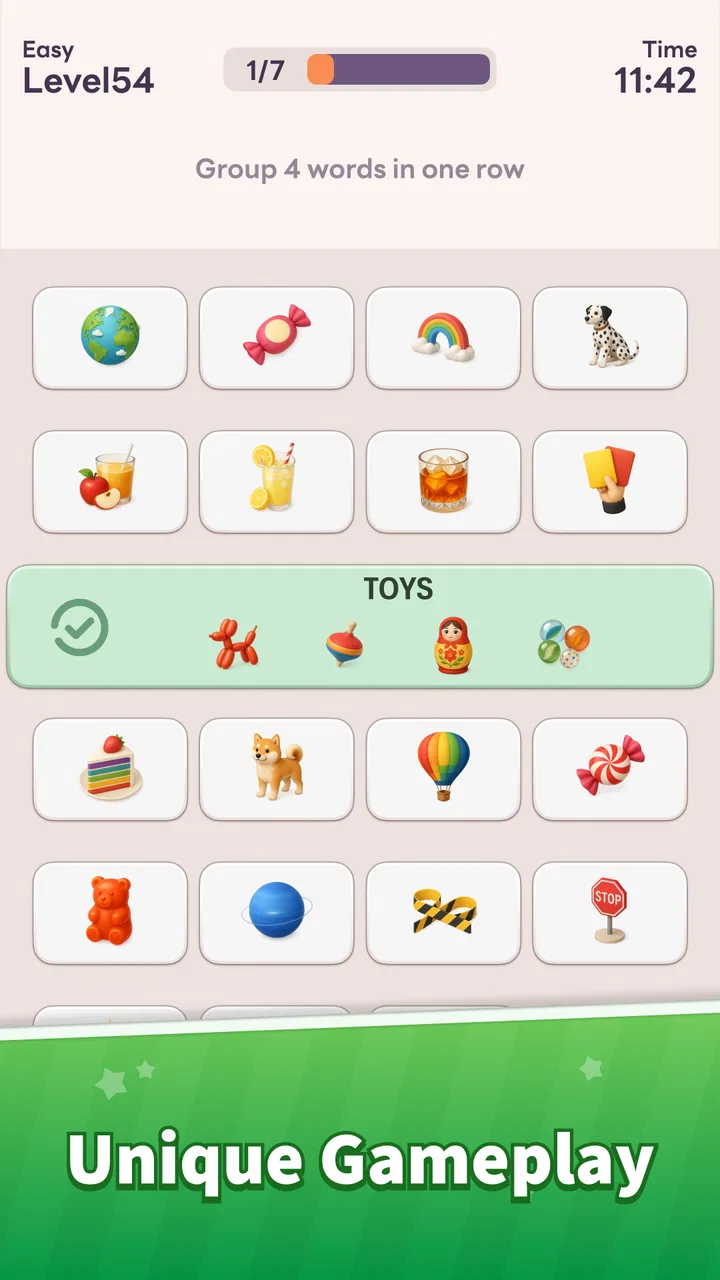
Word Associations Now! is the kind of word game I reach for when I want a short mental break rather than a long, story-driven session. Developed by LOST TEMPLE GAMES, it focuses on sorting and connecting words, so the appeal comes from noticing relationships, testing a hunch, and correcting yourself when a group is not as obvious as it first seemed. I found that simple idea more demanding than the clean store summary suggests, especially when several words appear to belong together.
It is free to download and sits in the word-puzzle section of mobile gaming. The game has a 4.6 average from around 6,000 ratings and has passed 100,000 installs, which gives it a useful level of player interest without making it feel like an enormous mainstream franchise. Its Teen content rating is worth keeping in mind for families choosing games for younger players. The current release is version 1.2.0, and it runs on devices using Android 8.0 or later.
Where the real friction begins
The first challenge is not installing the game; it is understanding how strictly each word should be interpreted. Association puzzles invite quick answers because a word can fit several ideas at once. That is also where mistakes happen. I often spotted a tempting connection, grouped it mentally, and then discovered that another word made the intended relationship more precise. The game rewards careful comparison instead of simply choosing the first reasonable match.
You May Also Like

 Blood Strike: 2.5 Anniversary
Blood Strike’s Loadouts Turn Every Drop Into a Tactical Gamble
A close look at Blood Strike’s custom loadouts: how fast access to signature weapons reshapes its battle royale rhythm, rewards preparation, and narrows the gap between fights.

 Pandora - Music & Podcasts
Pandora’s Music Is Easy to Start, but Harder to Recover
Pandora’s strength is its low-effort path from a seed to a station. Its weak spot is how much confidence it asks you to place in connection, setup, and quiet recovery.

 8 Ball Pool
 Is Built on Rivalries, Rematches, and Routine
A close look at the rivalries, rematches, shared routines, and unanswered safety questions that turn a quick pool match into a persistent mobile community.

 Samsung Music
’s Quiet Strength Is Playing What You Already Own
Its reach comes less from spectacle than from dependable access to a personal library. That simplicity is both the app’s strongest retention engine and its ceiling.

 AccuWeather: Weather Radar
AccuWeather Review: A Quick, Clear Forecast for Everyday Decisions
For everyday plans, the best forecast is the one you can understand quickly. AccuWeather makes rain timing, radar, and local conditions easy to act on, with a few trade-offs.

 Hill Climb Racing
Why Hill Climb Racing Still Turns Crashes Into One More Run
A tiny car, a bumpy hill and one more upgrade: Hill Climb Racing keeps resurfacing because its simple chaos makes every near-miss feel personal.
More From Our News Desk
View All News


That makes the experience different from a basic vocabulary quiz. You are not only asking whether two words are related. You are trying to identify the relationship shared by a set, while separating words that are deliberately close enough to distract you. A useful habit is to look for the strongest common link first and leave the vague words aside. If a connection needs a long explanation, it is probably weaker than one that is immediate and consistent.
New players may also get stuck because they treat every visible word as equally important. I had better results by scanning for unusually specific terms before dealing with broad ones. A word with several possible meanings can often be postponed, while a more distinctive word may reveal the intended direction of the puzzle. This small change makes the game feel less like guessing and more like organizing evidence.
Why a correct-looking group can still be wrong
The most interesting puzzles are built around overlap. Two words may share a general theme, but only one set has the same type of connection across all its members. For example, a group based on usage may compete with a group based on meaning, sound, or a familiar phrase. I learned to ask myself what kind of relationship I was using before committing to a solution.
This is also the main source of frustration. If you prefer word games with one obvious answer, some rounds may feel unnecessarily slippery. The difficulty comes less from obscure vocabulary and more from ambiguity. Players who enjoy lateral thinking will probably appreciate that tension, while anyone looking for a fast, relaxing matching game may find it tiring.
My practical advice is to avoid tapping through a puzzle too quickly. Read the whole board first, form several possible groups, and then compare them. When a proposed group leaves one awkward word behind, that is often a warning that the connection is too broad. This approach saves repeated failed attempts and helps you notice the puzzle’s intended structure.
Setup checks before blaming the puzzle
Because the game is free, getting started is straightforward in principle. I would still check the device requirements before downloading: Android 8.0 or newer is needed. On an older phone or tablet, the installation step is the first place to look if the game does not appear or behaves unexpectedly. Updating the operating system is not always practical, so this requirement may matter to people keeping an older device for casual games.
The version number is 1.2.0, and keeping the installed build current is a sensible first check when something feels inconsistent. A game update can affect loading, display, or puzzle behavior, so I would confirm that the store shows the latest available version before spending time on more complicated troubleshooting. Restarting the app after an update is also a simple step that can clear a temporary startup problem.
Storage and connection conditions are worth checking as well, even though they are easy to overlook with a small word game. If installation pauses, the device may be short on space or the connection may be unstable. I would close other downloads, retry on a reliable network, and restart the device if the store remains stuck. These are ordinary checks, but they prevent a false impression that the game itself is broken.
There is another setup decision that deserves attention: in-app purchases range from $1.99 to $24.99 per item. I would review the purchase controls on the device before handing it to a child or letting someone else play. The game is marked Teen, so it is not presented as a young-children title, but purchase awareness still matters on any free-to-start game. Treating the free download as the beginning of the cost conversation, rather than assuming every part of the experience is cost-free, is the safer approach.
A better first session
I recommend beginning when you have enough attention to read the words carefully. This is not because the controls are complicated; the challenge is mental. Playing while distracted makes broad associations seem more convincing, and that can create a frustrating chain of guesses. A quiet few minutes gives you a better sense of whether the game’s style suits you.
It also helps to decide what you want from the session. If you are using it as a quick break, stop after a few puzzles instead of forcing progress when the wording starts to blur together. If you are using it for deliberate practice, keep track of the kinds of links you miss: categories, phrases, meanings, or words with multiple uses. That self-review turns a casual game into a small exercise in flexible thinking.
For a shared family setting, I would play alongside the younger person rather than simply passing over the phone. The Teen rating means adults should make their own judgment, and the ambiguity of the puzzles can be more enjoyable as a conversation than as a solitary test. Discussing why one word belongs with a group can also reveal whether the problem was vocabulary, interpretation, or a misleading assumption.
Recovering when a round goes off track
When I reached an apparent dead end, the worst response was to keep rearranging the same group without changing my reasoning. A more reliable recovery method is to remove the least certain word from each proposed set and rebuild from the remaining terms. This exposes which connection was carrying the whole idea and which words merely happened to fit.
I also found it useful to classify the relationship in plain language. Is the group about things that can be done, words that commonly appear together, objects from the same area, or terms with a shared meaning? Naming the relationship makes vague intuition easier to test. If I could not describe the link in a short phrase, I treated that group as provisional rather than final.
Another good recovery step is to search for the pair that seems most distinctive. A pair with an unusually strong connection can act as an anchor, but it should not automatically determine the entire solution. After identifying it, I checked whether the other words matched the same kind of relationship. This prevented me from building a group around a clever pair that did not generalize.
Short breaks are surprisingly useful here. After staring at the same arrangement, every association starts to look equally plausible. Closing the game for a moment and returning with fresh attention can reveal a connection that was visible all along. I would rather pause than turn a word puzzle into a test of patience.
What to do when the game seems unresponsive
If a tap does not register, I would first check whether the screen is responding normally elsewhere. A temporary touch issue, a crowded background process, or a device that needs a restart can look like a game problem. Closing the game completely and opening it again is a reasonable first response, followed by checking for an available update.
If the issue appears only on one round, I would avoid repeatedly tapping the same area. Reopen the game and see whether the board returns normally. If the entire device is slow, the better fix may be freeing storage, closing other apps, or restarting the phone rather than reinstalling immediately. Reinstallation should be a later step, since it can disrupt whatever local progress the game keeps on the device.
For any problem involving purchases, I would keep the troubleshooting focused on the store account and device settings as well as the game. Confirming that the correct account is active and that the transaction status is clear can prevent duplicate attempts. I would not repeatedly press a purchase button when the screen appears delayed; waiting and checking the account history is safer.
When the app is not the cause
Word Associations Now! can feel difficult because of its design rather than a technical fault. A round that refuses to resolve may simply be using a broad word as a decoy. Before deciding that an answer is missing or that the board is wrong, I would reread every term and look for a more exact shared idea. The game’s central challenge depends on this kind of ambiguity, so difficulty alone is not evidence of malfunction.
Language background can also change the experience. Someone playing in a second language may understand each individual word but still miss common combinations or cultural associations. That does not make the game unsuitable, but it changes the source of difficulty. I would treat unfamiliar phrasing as a vocabulary challenge and use slower, more deliberate reasoning instead of assuming the puzzle is unfair.
Personal expectations matter too. Players coming from crossword apps may expect clues, while players coming from simple matching games may expect immediate visual feedback. This title asks for a different skill: grouping based on relationships that may not be explicitly explained. It is a better fit for people who enjoy interpreting language than for those who want a purely visual puzzle.
Compared with a traditional crossword, it is easier to start because there is no grid to fill and no long clue list to learn. A crossword usually gives you crossing letters that gradually confirm an answer; this game gives you competing associations and asks you to judge them directly. Compared with a word-search game, it is less about spotting letters and more about meaning. Compared with daily guessing games, it can feel less dependent on one hidden word and more focused on how several words interact.
Those differences explain when I would choose an alternative. I would pick a crossword when I wanted a slower, structured session with clues that narrow possibilities. I would choose a word search when I wanted something visually calming. I would choose a daily guessing format when I wanted a familiar routine built around one central answer. I would choose this game when I wanted to challenge my ability to shift between meanings and categories without a large time commitment.
Who will get the most from it
This is a strong match for players who enjoy vocabulary, categorization, and the moment when a confusing board suddenly makes sense. It also works well for short sessions during a commute break, a waiting room, or a quiet pause between tasks, provided the player is comfortable stopping when concentration fades. The free entry point makes it easy to test that fit without committing to a purchase immediately.
It is less suitable for someone who dislikes uncertain answers or wants every mistake to feel obviously deserved. The game’s appeal depends on close calls, and close calls can become irritating if you prefer direct rules. I would also skip it for a very young child unless an adult has checked whether the Teen rating and the language level are appropriate.
For people who play on older Android hardware, the operating-system requirement should be checked before making plans around it. For people who are sensitive to optional spending in free games, the in-app purchase range means device purchase controls deserve attention from the start. These are not reasons to reject the game automatically, but they are practical conditions that affect whether the experience feels comfortable.
My practical verdict after using it
My overall impression is that Word Associations Now! succeeds when I approach it as a reasoning game, not as a casual tap-to-match distraction. The word-sorting idea is easy to understand, but the best rounds make me reconsider assumptions, separate strong links from loose ones, and pay attention to the exact nature of a relationship. That gives it more depth than its compact format initially suggests.
The main limitation is the same feature that gives it character: ambiguity. When the intended connection is clear in hindsight, the puzzle feels satisfying. When several interpretations remain equally convincing, progress can feel less elegant. The game is therefore best for patient players who enjoy revising a theory. If you want a predictable, low-effort pastime, a simpler word game may be a better choice.
I would start by checking device compatibility, confirming the current version, and setting sensible purchase controls. During play, I would scan the entire board, identify the most distinctive terms, describe each proposed relationship in plain language, and take a break instead of repeating the same failed arrangement. Those habits address most of the friction I encountered without turning troubleshooting into a project.
My recommendation is positive, with a clear condition: choose it if you enjoy wordplay that rewards careful interpretation. The free download makes experimentation easy, while the Teen rating and optional purchases call for ordinary adult awareness. For me, it is a worthwhile pick when I want a focused mental reset and a more thoughtful alternative to basic matching games. I would not recommend it to someone seeking guaranteed answers, a story campaign, or a completely frictionless experience.
In short, Word Associations Now! is a focused word game from LOST TEMPLE GAMES that earns its place through the quality of its decisions rather than through complicated presentation. Its strongest moments come when a messy collection of words resolves into one precise pattern. If that kind of small discovery sounds rewarding, it is worth trying; if ambiguity feels like work, another word-game format will probably serve you better.
FAQs for Word Associations Now!
01What is Word Associations Now! and how does it work?
Word Associations Now! is an engaging word game that challenges players to think creatively by connecting words through associations. Players are presented with a word and must come up with related words in a set amount of time. It's designed to enhance vocabulary, improve cognitive flexibility, and provide hours of fun.
02Is Word Associations Now! suitable for all age groups?
Yes, Word Associations Now! is designed to be suitable for players of all ages. The game offers varying levels of difficulty, making it accessible to both children and adults. This versatility allows for family-friendly gameplay, educational purposes, and even competitive play among friends.
03Does Word Associations Now! require an internet connection to play?
Word Associations Now! can be enjoyed offline once downloaded, making it perfect for on-the-go entertainment. However, certain features such as leaderboards, multiplayer modes, or updates might require an internet connection to function properly. Check the app settings for more details.
04Are there any in-app purchases in Word Associations Now!?
While Word Associations Now! is free to download, it may offer in-app purchases to enhance the gaming experience. These could include additional word packs, hints, or ad-free gameplay. Players can choose to purchase these items to customize their experience, but they are not necessary to enjoy the core game.
05How does Word Associations Now! handle user data and privacy?
Word Associations Now! prioritizes user privacy and adheres to standard data protection policies. The app collects minimal user data necessary for gameplay and improvement. Users can review the privacy policy within the app for detailed information on data usage, third-party services, and how their information is protected.
Pros
- Enhances vocabulary skills effectively.
- User-friendly interface for easy navigation.
- Wide range of word categories available.
- Encourages creative thinking and learning.
- Regular updates with new content.
Cons
- Limited offline functionality available.
- Some in-app purchases are pricey.
- Ads can interrupt gameplay frequently.
- Requires constant internet connection.
- Occasional bugs in word suggestions.

Word Associations Now!
Gallery